
Serious Play – Mini-Munich, Something More Than Children’s Entertainment
By Horst Rumpf
First published in ‘Die Kinderstadt: Eine Schule des Lebens’, Gerd Grüneisl and Wolfgang Zacharias (1989). English translation by Daniel Fetz.
Children behind bank counters, in city councils, as mayors, as newspaper and television editors, as employees in registration offices, as workers in a furniture workshop, in a stonemason’s workshop – naturally, none of that is possible. They lack all the prerequisites, we think. Not just in ability, but also in seriousness, in accountability, in responsibility. And besides, child labor is forbidden, in the interest of children, as we like to say. And so we let them grow up in the children’s ghetto, let them dream of what will happen “when I grow up someday.” They remain, as if it were only natural, locked out of the serious realities of life – immature, in need of supervision, not to be taken seriously.
And for a long time, adults also projected their ideals onto this sheltered realm; childhood, in different periods, became a faithful reflection of adult longings: be it the longing for an idyll of purity and blissful harmony with oneself and the world, unburdened by any hardship; be it the longing for the pure, unalloyed expression of idealized masculinity or femininity – here the boy playing war games or tinkering with machines, there the little doll-mother at her toy kitchen; here the brave, battle-hungry lad who devours adventure books – there the tender, affection-seeking girl, groomed for beauty, who reads “Trotzkopf” and learns nothing of the men’s world. The history of childhood over the last 200 years is a history of the exclusion of childhood from adult life. The most striking manifestations of this today can be seen in the so-called children’s playgrounds – here the little ones are allowed, often behind fences, to romp around on the equipment, in the sandboxes that have been carefully prepared and approved as age-appropriate. Adults are forbidden to use them. Here children perform a kind of duty – “play officials,” as someone has called them.
Of course, with this seemingly unavoidable exclusion, we have also maneuvered ourselves into a difficult situation – and one that becomes clearer to us from year to year. For they are supposed to grow up after all. How can one prepare someone for something when you systematically lock them out of it?
To take the sting out of this contradiction, a whole range of children's activities were invented and imposed that have something of the squaring of the circle about them: they keep children away from real life and at the same time prepare them for it, or so it is said. The most famous of these inventions is compulsory schooling – spatially and temporally isolated from the world, this same world is then conveyed in small doses as so-called course material that one must absorb while sitting, listening, writing, reading, and answering. And this happens along a carefully planned and mapped-out obstacle course that also goes by the name of curriculum or lesson plan – it is driven by parents and teachers who never tire of emphasizing the importance of this rather monotonous procedure for later life. And these periods of formal schooling now extend for more and more people deep into the third decade of life, and they now begin as early as preschool.
Naturally, alongside school there are also all kinds of substitute measures for the life still to come – after all, you can’t simply put children on hold until they are grown up. There remains something disruptive about them, and one must somehow keep them busy to pass the time. The shop window of any toy store displays phantoms of the adult world in abundance, phantoms on which children’s fantasies are supposed to feast. And alongside children’s encyclopedias and children’s books, the media are extremely active in keeping children engaged, offering a peculiar pseudo-participation in the adult world to anyone willing to be drawn in. It even got to the point that authors like Postman (1983), in response to children – and the adult world as well – being flooded by flickering television images, put forward the thesis that the distinction between child and adult was fading. Because both groups were killing time in the same ways, because both were relying on the same sources of information.
However: There can be no doubt about the exclusion of childhood from responsible and conflict-filled adult life. And this state of affairs remains problematic. The more thoroughly the media penetrate every pore of children’s lives, the more built-up and car-dominant the environment becomes, the more eagerly educators search for opportunities where children can still do something serious, where they encounter realities rather than media phantoms and can feel that their own actions matter and have consequences for real life. Here lie the roots of initiatives for so-called “practical learning”; in schools, practical work projects are being tried in which the outcome is something other than papers filled with writing and school grades. Here a pizza oven is built and put to use, there an ecological school garden is created out of a green field. Here environmental research institutes offer “research visits” for students, there various “Olympiads” in mathematics and the natural sciences are promoted. There seems to be a widespread willingness to take the next generation one step further out of the illusory world of school and childhood.
And yet: Even when adolescents are allowed to get a little involved in political issues, write letters to the editor, and reenact political debates in the classroom with assigned roles, only a narrow crack opens onto so-called real life; and despite all good intentions, much of it feels like a pedagogically strained substitute. Money and power stay outside. The educators seem compelled to make sure the involvement doesn’t get too serious.
How, against this background, should one assess “The City of Children,” which existed and pulsed for five weeks in the summer of 1988 in a hall in Munich’s Olympic Park? What there was to see, to hear, to touch, to do, to talk about – it considerably upset the ingrained expectations regarding pedagogically arranged children’s activities. Was it illusion? Was it reality? The certainties in one’s assessment began to waver after just a few hours of involvement in it.
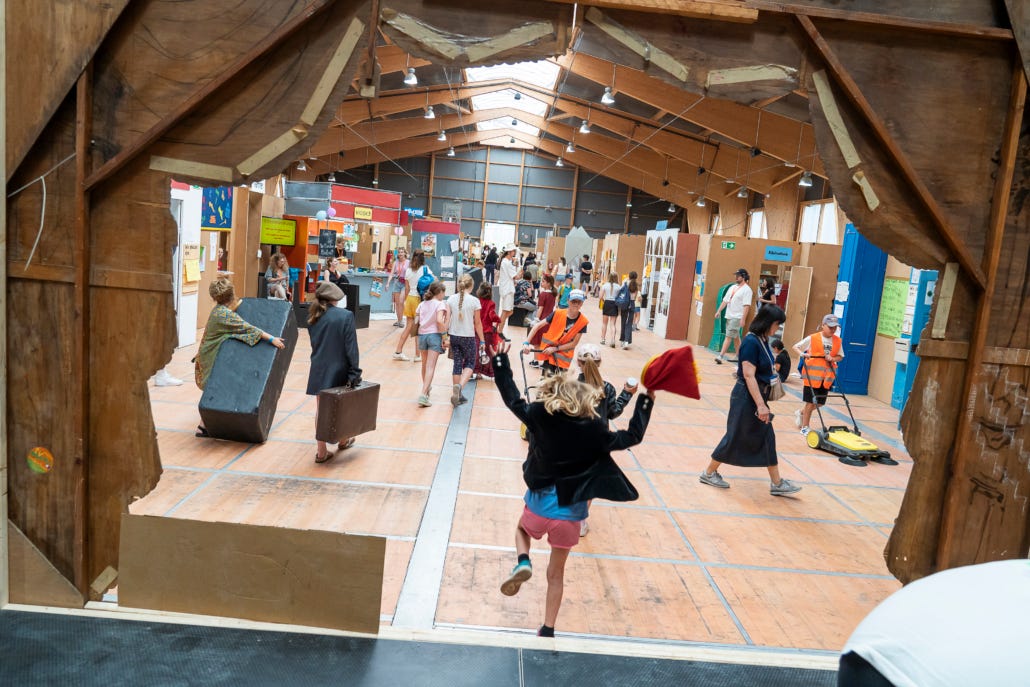
There sit children behind the counters of an employment office, issuing work permits, matching other children with jobs, managing scarcity, and grappling with directives from the city administration; right next to them sit others in the bank, checking permits and paying out the city’s own currency as wages for work done in the city, which can then be used to buy things there (food, newspapers, event tickets, taxi rides, handicraft products, etc.); children work in workshops where usable, saleable objects are produced (under the guidance of adult counselors skilled in the crafts). I recall briefcases, baskets, jewelry brooches, pottery, glassblown items, woven fabrics, stonework. Children work in a newspaper editorial office where hectic activity breaks out around midday – because the newspaper must be finished by 5 PM; on 10 typewriters, articles, advertisements, news items, and letters to the editor are typed. Children are out with television crews gathering material for the daily news show, which is broadcast daily at 5 PM in the screening room, presented by an elegantly self-assured thirteen-year-old anchor; the recorded material is reviewed and edited in the studio. In the city council assembly, the delegates struggle with a large agenda (Do we need a police force? Are the newspaper editors to be relieved of the obligation to attend university courses? Should there be a street named after Georg Kronawitter, the Munich Lord Mayor who was so noble as to open Mini-Munich with real TV coverage?)
Children also sit at the overburdened administrative offices of this remarkable city: at the registration office, where every child who wants to work and live in the city must register, and, as mentioned, at the employment office, in front of whose counters there are usually long lines. That is where the so-called work cards are issued, entitling their holders to work at a particular job for one day. Long as the list of professions was, actual openings were scarce on the days of my visit. In terms of professions, Mini-Munich had quite a lot to offer: furniture maker, city guide, architect, city gardener, computer expert, cook, glassblower, postal worker, museum curator, actor, garbage collector, auto mechanic, parent counselor, taxi driver, etc. On the work card, once the work is completed, the hours worked are recorded: a flat wage of 5 MiMüs (the city currency), 1 MiMü tax deduction. Upon returning the card, the wages are paid out – at the bank, in front of whose counters there were always lines as well. Once a week, city council members and mayors are elected by the citizens’ assembly.
A major role in Mini-Munich is played not by the school, but by the university, which has a beautiful lecture hall with elegant seating: you can tell from the space that what happens there is considered important and is not regarded as superfluous academic drudgery. Participation in courses is compensated with the same wage as other work. Parents, adults who roam the city, children, counselors – they can all offer courses for an honorarium of 8 MiMüs per hour! And about interesting topics – S.R., 15 years old, advertises for lecturers in the newspaper: “Any hobby, almost any topic will be accepted (nothing too boring like, e.g., poetry analysis or the like)”; MiMüZ, Issue 4, July/August 1988. One can only become a full citizen after completing a certain number of university course hours. Here are some course topics I noted down: juggling for beginners, first aid, massage, jazz dance, self-defense, photography course, art in Bavaria, acting school. Other cultural institutions: the museum, which had prepared a shoebox exhibition (the challenge was to create a stimulating arrangement inside a shoebox); the theater (with a perfect stage and richly stocked props and costume room)...
Perhaps the reader is thinking, with some impatience and skepticism, during this enumeration: What kind of fantasy world is actually being described here? How is all this possible – in the limited space of a hall? How is it supposed to work – with these critical youngsters, who are supposedly so skeptical that they see through any pretense?
And I confess, the same questions would have occurred to me had I not experienced this city in action for two days. And another question will impose itself on the reader of such a pale account: Even if all this somehow works – isn’t it ultimately a pedagogical Pied Piper scheme designed to drive out children’s last remaining sense of reality? After all, between 1,000 and 2,000 children come there daily of their own free will to make Mini-Munich into their city. So is this the ultimate form of children’s ghetto, or does it open a way out of that ghetto? Is Mini-Munich emptying the last squares and streets of Munich where children could still roam freely – in order to draw them into a pedagogically contrived event? No easy question – no question to which there can be an indisputable answer; a question in which the entire difficulty of our dealings with children is reflected, ever since the children’s idyll and the retreat into a nature-life remote from society, which we long tended to equate with children’s holiday happiness, came to an end.
The unique initiative of the Munich Pedagogical Action is based on two ideas:
1. It should surely be possible not to teach children about a world distant from them, or to bring them into contact with it only through toy and television phantoms in a sham way; it should surely be possible to involve them actively in a social reality that they create and maintain day by day according to transparent and agreed-upon rules of play, and that they can control or change through something like a public sphere in which debate unfolds and information circulates. It should surely be possible to invent and create a social fabric that holds together the activities fragmented in children’s daily routine (just think of the terror of today’s leisure schedules for children!) so that a manageable, reasonable context of action emerges from the externally controlled chaos.
2. It should be possible to acknowledge and bring to bear the forces in children that normal education tends to undervalue or relegate to the realm of the most trivial children’s entertainment: the forces of imagination ignited by tangible objects and events; the forces of identification that let them easily slip into unfamiliar roles – the potentials, then, that schooling fixated on concept-oriented learning still treats as something that doesn't truly matter when it comes to practical competence in life or even capacity for academic study.
The passion children have for turning themselves into others, and for transforming objects, places, activities through a magic stroke of imagination – this passion need not necessarily lead away from reality. Eight-year-old Andreas with the red cap on his head and the (real) garbage bin on wheels is one of the sanitation workers on duty, dispatched by the cleaning department onto the city’s streets. And by the power of assuming this role, which he takes very seriously, he will develop a different awareness of the dirt on streets and the problems of street cleaning than even the most astute and vivid school lessons could achieve. The staff of the advertising office, where all advertisements must be registered, also create slogans and billboards on behalf of various institutions (the theater, the museum, the city gardening department). They grapple with questions of quality, even with disputes — and through playful action they come to understand and judge such matters far more than any classroom instruction that merely analyzes advertising texts could ever accomplish. And children who are constantly bombarded with survey results in the media have a good chance of becoming somewhat more discerning once they have stepped into the role of researchers in Mini-Munich and surveyed many passers-by on the street – for example, about what they think of the heat in the hall (”unbearable,” “refreshing,” “still okay,” “driving me crazy,” “way too hot” – as reported in Issue 4 of MiMüZ = Mini-Munich Newspaper 1988).
And when one considers the effort it often takes to get children to write in school contexts – they mostly do it only because it is assigned and prescribed – one may be astonished at how much and how passionately writing takes place in Mini-Munich: the city council page in the newspaper contains the minutes of the public city council meeting from the previous day (24 agenda items); minutes of the citizens’ assembly appear in the same issue. What is striking is the seriousness and attentiveness of the minute-takers.
Everywhere, the imagination of those who take on roles becomes the medium through which they playfully come to know the features of the serious adult world surrounding them. And the whole body is always involved, never just the writing hand, while the body on the school bench is kept still. And mistakes are never pointed out through red marks and grades – always through the consequences of actions, through protests and objections of others who feel, for example, poorly, incorrectly, or incomprehensibly informed.
Yet another example of the characteristic mixture of fantasy and reality that has such an enlivening effect on the actors of Mini-Munich, in ways one could never have designed at a drawing board: the fourteen-year-old female Lord Mayor sits on the prominently elevated Lord Mayor’s chair in the beautiful city hall (the Theatine Church and Frauenkirche are painted on the back wall like a stage set) and presides, while (on August 3, 1988, at 3 PM) the architect and caricaturist E. M. Lang gives opening remarks for the architecture competition (”What is my vision for the city of tomorrow?”). So this is by no means a children’s paradise completely sealed off from the real Munich. Lang reports on real problems, real initiatives. The serious world is repeatedly brought in – a remarkable balance that can be demonstrated through many examples from these five weeks of city life.
The underlying question, which all similar projects of cultural work with young people must face, is: How does Mini-Munich prevent the imagination from running wild and growing out of control (as indeed happens in some leisure paradises, which obviously succumb to the danger of infantilization)?
A substantial dose of seriousness and commitment has been mixed into this play through various means. It is not about a loose, disconnected sequence of didactically tinged children’s leisure amusements. The employment and compensation rules are binding, as are the rules for participation in civic rights. Not everyone can do whatever they want for as long as they want – given the scarcity of jobs, that is obvious. The seriousness and sense of commitment that mark these activities also depend on the stimulating, guiding, advising, helping presence of approximately fifty adult counselors in the workshops, offices, editorial rooms, and cultural venues. They are available and can be called upon by the children. They guide things so that presentable and usable products are created – in basket weaving, furniture making, television production, in the computer room, in the city gardening department, in the pottery workshop, in the theater. The counselors can do what they show and teach the children at their request – and children evidently sense this real competence immediately, and they join in. Finally, besides the binding rules and the competent people, there is a third resource of seriousness to mention: the materials, the equipment are “real.” These are not mock-ups for pedagogical purposes: real television equipment, real computers, a real glassblowing workshop; weatherproof huts whose roofs must actually keep out the rain are built; a serious stage with real spotlights – all of this demands careful handling. Anyone who works with these devices and materials knows from the outset that they are being taken seriously.
And on top of all this comes the scrutiny exercised by the city’s public sphere, which is ceaselessly supplied with material for discussion by newspapers, television, bulletin boards, and research activities. If something goes wrong in the kitchen, for example (a snail in the salad, due to careless salad washing) – then it can be in the newspaper that evening – and three people from the kitchen are in the television studio the next day to answer the news anchor’s questions...
In the ten hours that I roamed this children’s city over two days, I saw nothing of what makes our schools so difficult: no rowdiness and yelling, no petty games of aggression that betray boredom and weariness, feelings of uselessness; no admonitions and warnings, no urging to work, no threats. And that is saying something given the presence of over 1,000 children between the ages of 6 and 14 in a single hall. Cheerful activity, certainly also turbulence, confusion, and overload – but not a trace of paralyzing passivity and indifference. Anyone who has heard the complaints about children who can no longer concentrate, who are no longer interested in anything because they – over-informed – already believe they know everything, may be astonished at the seriousness and concentration in these faces and gestures; at the will to do something sensible themselves and to help sustain and co-produce this social fabric.
And with all the seriousness: this city, even in its physical design, also has something of a grand spectacle, a theater about it. Actors on the stage of Mini-Munich. Also great fun. Enough fun that reality doesn’t become deadly serious and crushing; enough seriousness that the surplus of fun doesn’t become childish.
Anyone who has a sense of the barrenness of our pedagogical landscape may consider this Mini-Munich, in which open, unplanned life is coaxed forth and encouraged, to be improbable to the point of impossible. Anyone who dismisses it as mere pretense has either not looked closely enough, or else is acting out of self-defense – because they sense a threat to cherished, if questionable, traditions of dealing with young people.
This is not a miracle. It is skilled pedagogical work: devising and creating an environment that entices children to engage with it. An environment that has fantastical features and yet does not lead away from the “real world,” but on the contrary brings the real world into immediate, personal proximity, in a way entirely different from school instruction or media consumption.